
MILITARYCORRUPTION.COM — SPECIAL INVESTIGATIVE REPORT
For generations, Americans have opened their wallets, donated household goods, and volunteered countless hours to support the men and women who served their country.
Their generosity rests upon a fundamental expectation: that organizations receiving those contributions will manage them responsibly, spend them effectively, and provide an honest accounting of the results.
That expectation applies to Vietnam Veterans of America (VVA) just as it does to every other charitable organization.
VVA’s history of advocating for veterans deserves recognition. Its financial operations deserve equally serious examination.
Recent independent assessments of VVA’s fundraising practices have raised substantial questions concerning the cost of obtaining charitable contributions, the classification of those costs, and the financial information available to members and donors.
Those questions deserve documented answers.
A TROUBLING DISAGREEMENT OVER THE NUMBERS
On October 23, 2025, independent charity evaluator CharityWatch published an analysis of VVA’s household-goods recycling program.
According to CharityWatch, VVA reported spending approximately 64 percent of its fiscal year 2025 expenses on programs.
CharityWatch’s independent calculation produced a substantially different result: 35 percent for programs and 65 percent for fundraising and other overhead.
The principal disagreement involved the accounting treatment of approximately $9.4 million in expenses associated with collecting and processing donated goods.
VVA treated those costs within its recycling operations. CharityWatch maintained that the costs were properly attributable to fundraising when evaluating the organization’s efficiency.
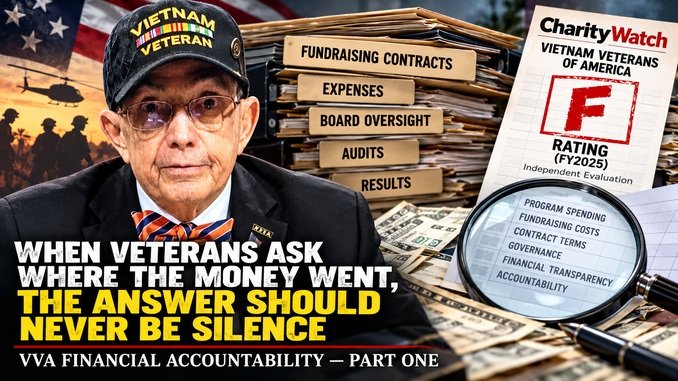
In an April 24, 2026 publication, CharityWatch identified VVA as receiving an F rating based on fiscal year 2025 data.
This was CharityWatch’s independent assessment, not a finding by a government agency that VVA or any officer had committed fraud.
Nevertheless, the difference between 64 percent and 35 percent is substantial enough to warrant careful examination.
It raises a basic question: How much of the value generated through charitable contributions ultimately supports veterans, and how much is consumed by the process of obtaining those contributions?
WAYNE REYNOLDS AND THE FINANCIAL LEADERSHIP RECORD

Wayne Reynolds has served multiple terms as VVA’s National Treasurer.
In his January/February 2024 Treasurer’s Report, Reynolds described VVA as financially strong and discussed the organization’s balanced budget and preparations for its eventual dissolution.
In January/February 2025, he reported that VVA remained in good financial condition while acknowledging that designated reserves for dues rebates had been depleted.
In his March/April 2025 report, Reynolds explained that the Board of Directors had adopted the fiscal year 2026 budget in accordance with his recommendations.
These statements provide important context for evaluating VVA’s financial planning.
They also demonstrate why the National Treasurer’s role deserves examination alongside that of the Finance Committee, executive management, and Board of Directors.
An organization may have adequate reserves, meet its budget projections, and nevertheless face significant questions about fundraising efficiency. Those conditions are not necessarily contradictory.
But members deserve to understand how the organization’s leadership reconciles its favorable financial assessments with CharityWatch’s substantially less favorable evaluation.
Financial leadership should be measured not merely by whether a budget was approved, but by how clearly financial performance and risks are communicated to those the organization serves.
FUNDRAISING CONTRACTS: WHO APPROVED WHAT?
VVA’s household-goods collection operations involve relationships with commercial businesses.
Such arrangements are not inherently improper. Nonprofit organizations routinely contract with outside companies to collect donations, provide services, and generate revenue.
The important questions concern contract terms, financial performance, competitive review, and oversight.
- Who negotiated VVA’s fundraising agreements?
- What compensation arrangements were approved?
- What standards were established for evaluating contractor performance?
- How frequently did the Board review those arrangements?
- Were alternative approaches considered?
- And when fundraising costs increased or performance fell below expectations, what corrective measures were recommended?
These questions concern organizational governance, not presumed personal misconduct.
They should be answerable through contracts, financial statements, committee reports, and board records.
WHAT THE RECORDS SHOULD ESTABLISH
A meaningful independent review should examine VVA’s financial results over multiple years rather than relying upon a single accounting period.
It should distinguish gross receipts from net proceeds, operating deficits from changes in reserves, and accounting classifications from actual cash expenditures.
It should also determine whether the organization established measurable performance standards for its fundraising activities.
VVA’s leadership has discussed the financial implications of the organization’s long-term transition and eventual dissolution. Those circumstances may influence spending priorities, reserves, and budget decisions.
That context deserves consideration.
But organizational transition does not eliminate the need for financial transparency.
Indeed, it makes clear reporting particularly important.
THE RESPONSIBILITY OF THE BOARD
The National Treasurer does not operate in isolation.
VVA’s financial decisions involve its governing board, committees, officers, and professional staff.
Responsibility for financial oversight must therefore be examined according to the actual authority exercised by each participant.
Where decisions were made collectively, the records should identify those decisions and the reasons supporting them.
Where concerns were raised, the records should show how they were addressed.
Where financial performance was evaluated, the standards and results should be available for meaningful review.
This is the essence of responsible nonprofit governance.
AN OPPORTUNITY TO PROVIDE ANSWERS
MilitaryCorruption.com recognizes that independent charity ratings can involve methodological disagreements.
We also recognize that unfavorable financial assessments do not establish dishonesty or personal misconduct.
For that reason, VVA’s leadership should have a meaningful opportunity to explain the organization’s accounting practices, fundraising arrangements, and financial results.
If CharityWatch’s conclusions are disputed, VVA can identify the points of disagreement and present supporting evidence.
If improvements have been implemented, members and donors deserve to know what changed and why.
If the records establish that decisions were reasonable under the circumstances, that information deserves publication as well.
The objective should be a complete and accurate accounting.
THIS IS ONLY THE BEGINNING
This report begins a continuing MilitaryCorruption.com examination of VVA’s financial management, fundraising arrangements, and governance practices.
Subsequent installments will examine specific records, documented decisions, and outstanding questions as additional evidence becomes available.
Wayne Reynolds’ published statements and financial leadership responsibilities will remain relevant to that examination, as will the responsibilities of other officers and directors.
MilitaryCorruption.com invites those individuals to provide documentation, explanations, corrections, and opposing viewpoints.
Veterans have spent their lives being held accountable for the responsibilities entrusted to them. They are entitled to expect the same commitment to accountability from organizations established to serve them.
The records should speak.
The questions should be answered.
And the truth should determine the conclusions.
BECAUSE WHEN VETERANS ASK WHERE THE MONEY WENT, THE ANSWER SHOULD NEVER BE SILENCE.
— MILITARYCORRUPTION.COM
SOURCE DOCUMENTATION
- CharityWatch — Vietnam Veterans of America’s Recycling Program, Debunked Again, October 23, 2025.
- CharityWatch — Patriotism for Profit: Inside the Business of Veterans Charities, April 24, 2026.
- Wayne Reynolds — A Balanced Budget for FY 2025, January/February 2024.
- Wayne Reynolds — Facing the Fiscal Realities of the Coming Dissolution, January/February 2025.
- Wayne Reynolds — The New Budget, March/April 2025.
OUR COMMITMENT TO TRUTH AND FAIRNESS
MilitaryCorruption.com (MCC) is interested in one thing above all else: THE TRUTH.
Our mission is to expose wrongdoing, demand accountability, and report matters of public concern without fear or favor. We recognize that every story has more than one perspective and that every person deserves a fair opportunity to be heard.
If anyone identified or discussed in an MCC article believes they have been unfairly characterized, misrepresented, maligned, or that material facts have been omitted, we invite that individual to contact us immediately and provide their version of events.
We welcome corrections, contradictory evidence, and opposing viewpoints.
In the interest of fairness and transparency, MCC offers individuals criticized in our reporting a meaningful opportunity to respond, including publication of their rebuttals with prominence comparable to the original allegations.
Those wishing to submit a rebuttal for publication without editorial alteration may do so. MCC will honor that request provided the submission complies with applicable law and does not contain unlawful threats, incitement to violence, or other legally prohibited material.
A rebuttal submitted as a signed, sworn statement will be published verbatim, subject to those same limitations, verification of authenticity, and protection of legally confidential information. MCC will not silently alter the substance of such a statement.
Publication of a rebuttal does not necessarily constitute MCC’s agreement with its contents. Likewise, disagreement with our reporting does not diminish anyone’s right to challenge it.
If we discover that we have published a material factual error, we will correct it promptly and transparently.
We do not claim a monopoly on the truth. We insist only that the truth deserves to be heard.
MILITARYCORRUPTION.COM
Because Accountability is Important


