
MILITARYCORRUPTION.COM — SPECIAL EDITORIAL
WASHINGTON, D.C. — November 23, 2026
There is an old saying that politics is the art of looking for trouble, finding it everywhere, diagnosing it incorrectly, and applying the wrong remedies.
After witnessing portions of the November 17, 2026, Senate Armed Services Committee confirmation hearing for Acting Secretary of the Navy Hung Cao, one might reasonably wonder whether that description should be permanently engraved above the entrance to the United States Capitol.
America’s Navy is confronting serious challenges. Extended deployments, mounting maintenance requirements, depleted munitions inventories, shipbuilding deficiencies, and the physical and psychological toll of sustained military operations are hardly trivial matters.
Yet Washington has once again demonstrated its remarkable ability to transform a consequential examination of military leadership into a political spectacle.
And when that happens, the people who ultimately pay the price are seldom the politicians.
They are the sailors and Marines.
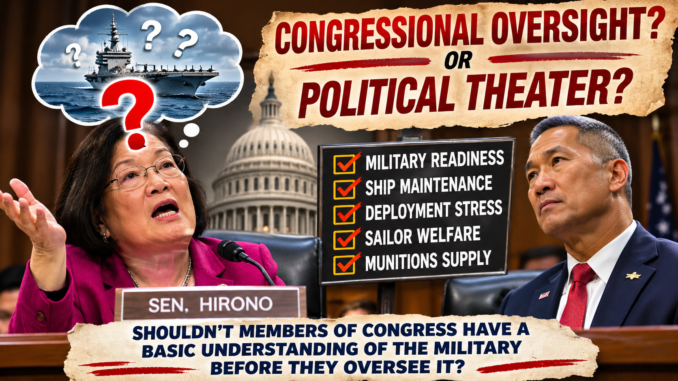
THE SENATOR FROM HAWAII
Senator Mazie Hirono (D-HI), a member of the Senate Armed Services Committee, attracted considerable attention when she questioned Hung Cao during his confirmation hearing to become the permanent Secretary of the Navy.
Hirono began with two questions concerning sexual misconduct.
She asked whether Cao, since becoming a legal adult, had ever made unwanted requests for sexual favors or committed sexual harassment or assault.
Cao answered that he had not.
She then asked whether he had ever faced disciplinary action or entered into a settlement concerning such conduct.
Again, Cao answered in the negative.
Now, before anyone rushes to defend or condemn the senator, a few facts deserve recognition.
Hirono has asked similar questions of numerous nominees over the years. She did not invent them specifically for Cao, and nothing in the exchange establishes that she possessed evidence suggesting he had committed sexual misconduct.
Furthermore, the Senate unquestionably has a responsibility to examine the character and qualifications of individuals seeking positions of extraordinary public trust.
Sexual harassment and assault are serious problems within the armed forces. They warrant serious scrutiny.
But there is another question worth asking.
When does legitimate congressional vetting become a rehearsed political performance, and how much does that performance actually accomplish?
A nominee can answer two standardized questions in less than a minute. That may establish a position on the record, but it is no substitute for examining relevant evidence, reviewing complaints, evaluating command decisions, or investigating actual allegations of misconduct.
If Congress wishes to protect service members from sexual abuse, MCC would suggest that its members devote at least as much energy to ensuring that substantiated allegations are properly investigated and offenders held accountable as they devote to asking nominees whether they have ever committed such offenses.
That would be oversight with consequences.
HUNG CAO IS NOT YOUR TYPICAL WASHINGTON BUREAUCRAT
Hung Cao’s background deserves consideration, regardless of one’s political affiliation.
Born in Vietnam, Cao came to the United States as a refugee following the communist takeover of South Vietnam.
He subsequently graduated from the United States Naval Academy and served more than 25 years in the Navy, retiring as a captain.
His military career included service involving explosive ordnance disposal and deployments supporting special operations forces in Iraq, Afghanistan, and Somalia.
Whatever one thinks of President Donald Trump, his administration, or Cao’s political views, those credentials are not imaginary.
They were earned.
Cao has experienced military service in circumstances substantially different from the committee rooms and political offices of Washington.
That experience does not automatically qualify him to manage the Department of the Navy. Operational competence and civilian executive leadership are not interchangeable.
But neither should his experience be dismissed merely because he was nominated by a Republican president.
A serious confirmation hearing should examine whether Cao can translate his military experience into effective civilian leadership.
Can he improve shipbuilding?
Can he address maintenance backlogs?
Can he improve readiness without exhausting the men and women who make that readiness possible?
Can he protect sailors and Marines from bureaucratic indifference?
And, perhaps most importantly, will he tell Congress and the President what they need to hear, even when the truth is politically inconvenient?
Those questions matter considerably more than the political affiliations of the people asking them.
THE REAL SCANDAL MAY BE WHAT IS HAPPENING AT SEA
During the hearing, senators raised troubling questions about conditions aboard American warships operating under prolonged deployment schedules.
Reports concerning food supplies, living conditions, psychological stress, and suicide-related incidents aboard the USS Abraham Lincoln became part of an increasingly contentious examination of Cao’s leadership.
Senator Richard Blumenthal (D-CT) accused Cao of failing sailors and their families.
Cao rejected the suggestion that he was indifferent to their welfare, emphasizing that his own son serves as a United States Marine.
But Cao also drew criticism for characterizing reported suicide attempts as incidents in which suicide had been prevented through intervention.
There is an important distinction between recognizing successful intervention and minimizing the severity of the circumstances that required it.
Preventing a suicide is an achievement.
Allowing conditions to deteriorate to the point that suicide intervention becomes necessary is a problem demanding investigation.
The hearing did not establish that Navy leadership caused the reported incidents. Nor did it establish that every allegation about shipboard conditions was accurate.
But it raised questions that cannot responsibly be answered with political slogans, dismissive comparisons, or assurances that everything is under control.
If American sailors are being pushed beyond reasonable operational limits, Congress has an obligation to determine why, who is responsible, and what corrective action is necessary.
That obligation applies regardless of whether the Secretary of the Navy is a Republican appointee or a Democrat appointee.
SENATOR HIRONO ACTUALLY RAISED A LEGITIMATE QUESTION
Here is where this editorial may surprise some readers.
After her preliminary questions concerning sexual misconduct, Hirono turned to a subject of considerable importance: the effect of military operations against Iran on naval readiness.
She raised concerns about munitions expenditures, ships diverted from the Indo-Pacific, maintenance delays, and the effects of extended deployments.
Those are not frivolous questions.
They go directly to the Navy’s ability to fulfill its worldwide commitments.
Cao acknowledged that the conflict was stressing naval resources.
The senator also questioned whether Navy leadership had adequately communicated the consequences of sustained operations to senior civilian officials.
That, too, is a legitimate subject for congressional inquiry.
MCC has no interest in manufacturing criticism simply because a question came from Senator Hirono.
A legitimate question remains legitimate regardless of the political party of the person asking it.
But legitimacy does not relieve a senator of the responsibility to conduct a hearing professionally, permit meaningful answers, and distinguish genuine oversight from political confrontation.
Likewise, a nominee’s distinguished military record does not excuse evasive answers or failures of leadership.
Both sides must be held to the same standard.
Unfortunately, that standard sometimes appears to be the first casualty of a Washington confirmation hearing.
WHEN THE POLITICAL PARTIES CONTROL THE QUESTIONS
Perhaps one of the more revealing moments of the hearing came not from Hirono, but from Republican Senator Mike Rounds of South Dakota.
Rounds raised concerns that Democratic members of Congress had been excluded from certain classified briefings.
His objection was straightforward: Congress cannot be expected to make informed national security decisions when relevant information is selectively provided according to political affiliation.
Imagine that.
A Republican senator questioning whether Democrats were receiving the information necessary to fulfill their constitutional responsibilities.
That is precisely the kind of bipartisan oversight the American people should expect.
National defense is not the private property of either political party.
The Navy does not belong to Republicans.
The Marine Corps does not belong to Democrats.
And the men and women who wear the uniform do not take an oath to defend the political interests of whichever administration happens to occupy the White House.
They swear an oath to the Constitution.
Congress should remember that distinction every time it convenes a hearing concerning military leadership.
ANOTHER QUESTION WASHINGTON SHOULD ANSWER
Cao’s nomination also presents an important statutory issue.
Federal law generally requires a seven-year interval between relief from active duty as a commissioned officer and appointment as Secretary of the Navy.
Cao retired in 2021.
Consequently, his appointment requires congressional consideration of an exception to that requirement.
The restriction exists for a reason: preserving civilian control of the military.
Cao’s military experience may be an asset, but the statutory requirement cannot simply be brushed aside because his résumé is impressive.
Congress must determine whether an exception serves the national interest.
That is a serious constitutional and institutional responsibility.
It deserves thoughtful consideration rather than political reflexes.
THE PEOPLE WHO NEVER GET A SEAT AT THE TABLE
There is another dimension to this story that deserves far more attention than it generally receives.
While senators debate military policy in comfortable, climate-controlled hearing rooms, American service members endure the consequences of decisions made thousands of miles away.
They miss birthdays, anniversaries, graduations, and funerals.
Their families endure uncertainty.
Their ships require maintenance.
Their equipment wears out.
Their physical and mental endurance has limits.
And when something goes wrong, those same service members can find themselves subjected to investigations, administrative proceedings, or disciplinary actions conducted by the very institutions responsible for their welfare.
MCC has spent years examining the imbalance between the authority exercised by military institutions and the resources available to individual service members attempting to challenge them.
That imbalance does not disappear when a new Secretary of the Navy takes office.
Nor does it disappear when control of Congress changes hands.
The system must be judged by how it treats the people who have the least institutional power to defend themselves.
That is where accountability begins.
THE MCC VERDICT
Senator Hirono is entitled to question Hung Cao aggressively.
She is entitled to challenge his judgment, examine his record, and demand explanations concerning naval readiness.
Indeed, she has a duty to do so.
But she is not entitled to a free pass from criticism when her conduct appears more theatrical than productive.
Likewise, Cao’s honorable military service does not place him beyond scrutiny. His decisions, public statements, and handling of sailors’ welfare must withstand rigorous examination.
Congressional oversight should not resemble a contest to determine which senator can produce the most provocative exchange for the evening news.
It should be an examination of facts, performance, judgment, and accountability.
America does not need a Senate Armed Services Committee that functions as a political demolition derby.
It needs a committee capable of identifying genuine failures, compelling truthful answers, and demanding corrective action.
If sailors are being subjected to unreasonable deployment schedules, investigate.
If ship maintenance is being sacrificed to meet operational demands, investigate.
If munitions inventories are being depleted faster than they can be replenished, demand answers.
If Navy leaders are minimizing legitimate concerns about personnel welfare, hold them accountable.
And if senators are using confirmation hearings primarily to score political points, the American people should hold them accountable as well.
The objective should not be to embarrass Hung Cao.
Nor should it be to protect him.
The objective should be to ensure that the United States Navy has competent leadership, adequate resources, and an institutional culture that places the welfare of its personnel alongside the accomplishment of its missions.
That is the standard MCC believes every member of the Senate Armed Services Committee should be required to meet.
And unlike the political theater that too often dominates Washington, that standard is neither Republican nor Democrat.
It is American.
MILITARYCORRUPTION.COM welcomes factual corrections, documented rebuttals, and opposing viewpoints from the individuals and institutions discussed in this editorial. Submissions should be civil, relevant, and supported by verifiable evidence. MCC reserves the right to edit submissions for clarity, accuracy, and legal compliance.


