Decorated Army Lieutenant Colonel Challenges Pentagon Contracting Instructions — Gets Reassigned, Disciplined and Fired. Federal Whistleblower Laws Raise Serious Questions About His Treatment.
MILITARYCORRUPTION.COM — SPECIAL INVESTIGATIVE EDITORIAL
BLOW THE WHISTLE — AND LOSE YOUR CAREER?
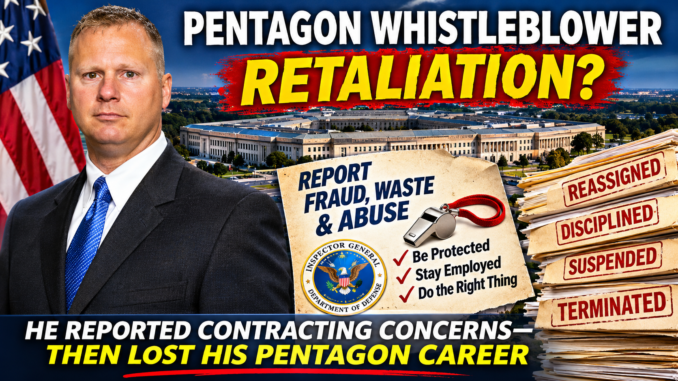
The Department of Defense encourages its employees to report fraud, waste, abuse and violations of federal law.
The Pentagon even advertises an Inspector General hotline where employees can report suspected wrongdoing without fear of reprisal.
Sounds wonderful, doesn’t it?
But what happens when a federal employee actually takes that advice, reports suspected misconduct involving senior management and suddenly finds himself fighting to save his career?
Ask retired Army Lieutenant Colonel Ricky “Rick” Lamberth.
After 32 years of military service, three combat deployments and years of civilian work involving government contracts, Lamberth says his career was destroyed because he refused to carry out a contracting instruction he believed violated federal law.
On March 10, 2025, the Pentagon removed him from federal service.
Management said he repeatedly failed to follow instructions and engaged in misconduct.
Lamberth says those disciplinary accusations were part of a retaliatory campaign that began when he challenged his supervisor over a proposed contracting action.
MilitaryCorruption.com has followed Lamberth’s allegations in several previous investigative editorials.
Now, additional reporting by investigative journalist Kyle Fields, published November 21, 2026, in The Whistleblower Files, has brought renewed attention to the dispute.
Fields’ report, From Contract Oversight to Dismissal: Rick Lamberth’s Pentagon Story, examines the contracting disagreement, Lamberth’s reassignment, disciplinary actions, removal and subsequent efforts to obtain relief.
But there is another dimension to this controversy that deserves far more attention.
Congress has enacted federal laws specifically prohibiting retaliation against employees who report suspected wrongdoing or refuse orders that would require them to violate the law.
Were those laws respected in Lamberth’s case?
Or did Pentagon management find ways to circumvent the protections Congress intended federal employees to enjoy?
Those questions deserve answers.
THE PENTAGON RECRUITED AN EXPERIENCED CONTRACTING PROFESSIONAL
In March 2022, Lamberth received an offer for a senior acquisition and program-management position within the Office of the Under Secretary of Defense for Acquisition and Sustainment.
His intended responsibilities included work involving the RAND National Defense Research Institute, one of the federally funded research and development centers supporting national defense.
Lamberth brought substantial experience to the assignment.
He had served in military logistics and contracting oversight, worked as a contracting officer’s representative and acquired professional certifications in program management and related disciplines.
He began the new assignment on April 24, 2022.
Less than a month later, according to his account, everything changed.
MAY 18, 2022 — THE CONTRACTING ORDER THAT STARTED IT ALL

Lamberth alleges that his immediate supervisor, Karan Williams, instructed him to inform RAND that ten projects would be withdrawn from its contract and transferred or awarded to another research organization, the Institute for Defense Analyses.
He says he questioned her authority to direct the action.
He also believed that the instruction conflicted with federal acquisition regulations.
When he requested written instructions, according to Lamberth, Williams became angry and ordered him to return to his office.
Lamberth says he subsequently reported his concerns to Clothilda Taylor, a senior official in his management chain.
He maintains that management failed to conduct an adequate investigation of his allegations.
The critical question is whether the proposed movement of projects complied with the contracts, applicable procurement rules and the authority delegated to the officials involved.
The available material does not establish that the proposed action constituted fraud or extortion. Those are serious legal characterizations requiring evidence beyond an employee’s account of a disputed instruction.
But it does raise a legitimate question:
Why wasn’t the contracting authority underlying the disputed instruction independently examined and explained?
FEDERAL ACQUISITION REGULATIONS
ARE NOT SUGGESTIONS
Federal Acquisition Regulation 1.602-1 establishes that contracting officers may bind the federal government only within the authority delegated to them.
FAR 1.602-2 assigns contracting officers responsibility for ensuring compliance with contract requirements and protecting the government’s interests.
The regulations further restrict contracting officers’ representatives from independently changing contract price, quality, quantity, delivery or other contractual terms.
These limitations exist for a reason.
Government contracting involves enormous sums of taxpayer money. The rules governing who may authorize contractual changes are essential safeguards against unauthorized commitments, favoritism and misuse of public funds.
Lamberth contends that Williams lacked the authority to issue the instruction he describes.
Whether she actually lacked such authority, and whether the contemplated action required a contracting officer’s formal approval, must be established by examining the relevant contracts and delegations of authority.
An instruction to communicate a proposed change is not necessarily the same as an unauthorized contractual modification.
Nevertheless, an experienced acquisition professional who raises a specific concern about contracting authority deserves a serious, documented response.
The Pentagon should be able to identify the official authorized to approve the proposed action, the legal basis for that authority and the procurement procedures that applied.

CONGRESS SAID WHISTLEBLOWERS MUST BE PROTECTED
Now we come to the heart of this controversy.
Federal law expressly prohibits certain forms of retaliation against government employees.
Under 5 U.S.C. § 2302(b)(8), federal officials may not take covered personnel actions in retaliation for qualifying disclosures that an employee reasonably believes reveal violations of law, gross mismanagement, gross waste of funds or abuse of authority.
An employee does not necessarily have to prove that the suspected wrongdoing ultimately occurred.
The law protects qualifying disclosures based upon a reasonable belief, subject to statutory requirements.
Congress also recognized that employees sometimes face an even more difficult choice: obey a superior or comply with the law.
That is where 5 U.S.C. § 2302(b)(9)(D) becomes particularly significant.
This provision prohibits retaliation for refusing an order that would require an employee to violate a law, rule or regulation.
Read that again.
Federal law expressly addresses retaliation against employees who refuse orders requiring unlawful conduct.
The law also protects employees who lawfully cooperate with inspectors general or the Office of Special Counsel.
Those protections appear in 5 U.S.C. § 2302(b)(9)(C).
Whether Lamberth’s refusal qualifies under subsection (b)(9)(D) depends upon whether the instruction would actually have required him to violate a law, rule or regulation.
His disclosures and subsequent complaints may independently raise questions under subsections (b)(8) and (b)(9)(C).
These are distinct legal issues, and each deserves examination under its applicable standard.
THE PENTAGON CHANGED HIS JOB — THEN JUDGED HIS PERFORMANCE
Following the contracting dispute, Lamberth says he was removed from the acquisition and program-management work for which he had been recruited.
He was subsequently assigned to security-related duties.
In December 2024, he complained in writing to senior leadership that his occupational series had changed from NH-0343, associated with program and management analysis, to NH-0080, associated with security administration.
He contended that he had neither sought nor been adequately prepared for the change.
Lamberth further alleged that he was being required to satisfy performance expectations outside his professional background.
He received an unsuccessful appraisal, which he disputed.
Now consider another provision of federal law.
5 U.S.C. § 2302(a)(2)(A) identifies covered personnel actions that can be relevant to prohibited personnel practices.
They include transfers, reassignments, performance evaluations and disciplinary actions.
In other words, Congress did not limit whistleblower protections to cases where someone is immediately fired.
Retaliation can potentially involve earlier personnel decisions.
A reassignment, a damaging evaluation or a disciplinary action may qualify if the necessary legal elements are established.
That makes the sequence of decisions in Lamberth’s case particularly important.
Was his reassignment justified by legitimate organizational requirements?
Were his new duties appropriate for his qualifications and training?
Were the performance standards reasonable and consistently applied?
Did the officials responsible know about his contracting disclosures?
And did those disclosures contribute to the personnel decisions?
These questions should have been central to any meaningful review of his allegations.

THE PAPER TRAIL THAT ENDED HIS CAREER
The Pentagon’s disciplinary record did not begin with Lamberth’s dismissal.
A July 12, 2022, warning accused him of unprofessional conduct during interactions with management.
Additional disciplinary actions followed, including an April 2024 reprimand and an August 2024 five-day suspension without pay.
On December 20, 2024, management issued a proposed removal.
The final removal decision, signed by Security and Facilities Director Scotty A. Altizer, became effective March 10, 2025.
It cited repeated misconduct and failure to follow instructions.
Management’s stated position was that earlier disciplinary measures had failed to correct Lamberth’s conduct.
Lamberth’s position was entirely different.
He maintained that the disciplinary process was being used to punish him for challenging management and reporting suspected wrongdoing.
Neither position should be accepted merely because one side repeats it more forcefully.
The question is whether the disciplinary evidence supports management’s explanations and whether protected whistleblowing contributed to the decisions.
Under the applicable whistleblower-retaliation framework, once an employee establishes the necessary elements of a protected disclosure or activity and its contribution to a personnel action, the agency may be required to demonstrate by clear and convincing evidence that it would have taken the same action absent the protected conduct.
That is an important safeguard.
It prevents agencies from defeating every whistleblower claim simply by producing a disciplinary memorandum.
But it does not make every disciplinary action against a whistleblower unlawful.
WHAT DID THE PENTAGON’S SENIOR LEADERS KNOW?
AND WHEN DID THEY KNOW IT?
Lamberth says he reported his allegations through management channels and subsequently contacted federal oversight organizations.
Those included the Department of Defense Inspector General and the U.S. Office of Special Counsel.
By December 2024, senior acquisition leadership had received correspondence in which he expressly challenged his reassignment, performance requirements and treatment.
Management’s proposed removal followed later that month.
That sequence raises serious questions concerning the review undertaken before his dismissal.
Did an independent official investigate the original contracting allegation?
Did the responsible decision-makers evaluate whether Lamberth had engaged in legally protected whistleblowing?
Was the reassignment examined for possible retaliatory motive?
Were the disciplinary charges evaluated independently?
And what evidence established that removal was warranted regardless of Lamberth’s protected activities, if any?
MCC believes these are precisely the questions congressional oversight authorities should be asking.
AN ESTIMATED $850,000 IN PERSONAL FINANCIAL CONSEQUENCES
Lamberth describes an enormous personal price for challenging the Pentagon.
He estimates approximately $850,000 in investments and personal debt associated with the dispute and its consequences.
That figure represents his estimate rather than an independently verified damages calculation.
He also reports significant emotional, physical and family hardship.
He has pursued proceedings before the Merit Systems Protection Board and says he accepted a settlement under pressure related to possible criminal allegations.
The legal consequences of that settlement cannot be determined without reviewing its terms and the relevant MSPB records.
Nevertheless, his account illustrates a troubling practical reality.
An individual federal employee may be required to spend years challenging decisions made by an agency with substantial institutional and legal resources.
Even when a whistleblower ultimately obtains relief, the process itself may impose severe personal and financial costs.
Congress should examine whether existing protections provide timely and effective remedies.
THE WORKERS’ COMPENSATION DISPUTE
ADDS ANOTHER UNRESOLVED QUESTION
Kyle Fields’ investigative reporting also examined Lamberth’s federal workers’ compensation proceedings.
According to information supplied by the Department of Labor, Lamberth’s injury claim was initially accepted in August 2022.
That acceptance was later rescinded after his employing agency supplied video evidence disputing the reported circumstances.
On August 7, 2026, the Employees’ Compensation Appeals Board remanded the matter for further consideration.
The remand required additional review; it was not a final determination that Lamberth was entitled to benefits.
Nor did it establish that the employer had retaliated against him.
The Labor Department also reported that its Veterans’ Employment and Training Service could not comment on an open investigation.
These proceedings remain relevant to the broader history of Lamberth’s dispute, although they do not independently prove his whistleblower allegations.

WHERE WERE THE WATCHDOGS?
The federal government maintains an elaborate oversight structure.
Inspectors general investigate allegations of misconduct.
The Office of Special Counsel addresses prohibited personnel practices and whistleblower retaliation.
The Merit Systems Protection Board provides adjudicative review in qualifying federal employment disputes.
Congress conducts oversight of executive agencies.
Yet Lamberth says the institutions he approached did not adequately protect him.
The Defense Department Inspector General declined to confirm or deny the existence of an individual complaint when contacted by Fields.
The Pentagon and Defense Logistics Agency did not respond to that reporter by the stated deadline.
Those responses do not establish that misconduct occurred.
They do, however, leave the public without answers to important questions.
A government that encourages employees to report suspected wrongdoing must also demonstrate that its complaint procedures operate fairly and effectively.
Otherwise, whistleblower protection risks becoming little more than an attractive promise on an Inspector General poster.
MCC HAS BEEN FOLLOWING THIS CASE — AND WE ARE NOT FINISHED
MilitaryCorruption.com has previously examined Lamberth’s allegations, his reassignment, the disciplinary proceedings and his eventual dismissal.
In our earlier reporting, we questioned whether Pentagon management had used administrative procedures to remove an employee who challenged questionable contracting practices.
Our May 2025 report included Lamberth’s own written account and material from his removal decision.
In June 2025, MCC called attention to the case in an editorial addressed to the Secretary of Defense.
The latest independent reporting provides another reason to demand a full accounting.
The public deserves to know whether the underlying contracting instruction was proper and whether Lamberth’s subsequent treatment complied with federal whistleblower-protection law.
CONGRESS NEEDS TO ASK THE QUESTIONS
THE PENTAGON WON’T ANSWER
MCC calls upon the appropriate congressional oversight authorities to examine the circumstances surrounding Lamberth’s dismissal.
A meaningful inquiry should obtain and review:
- The contracts and acquisition records concerning the proposed movement of RAND research projects to IDA.
- The written delegations of contracting authority applicable to the officials involved.
- The documented reasons for Lamberth’s reassignment from acquisition-related work to security duties.
- The underlying evidence supporting his performance evaluations, reprimand, suspension and removal.
- The handling and disposition of his protected disclosures and retaliation complaints, consistent with applicable confidentiality requirements.
- The relevant MSPB decisions and settlement terms, subject to lawful disclosure restrictions.
The inquiry should afford all involved officials a fair opportunity to explain their decisions and present supporting evidence.
No one should be presumed guilty merely because a whistleblower makes an allegation.
But neither should a federal agency’s disciplinary decision be considered conclusive proof that its conduct was lawful.
Independent oversight exists to examine precisely such disputes.
THE PENTAGON’S WHISTLEBLOWER PROMISE IS ON TRIAL
Rick Lamberth says he tried to uphold the rules governing federal contracting.
The Pentagon says it fired him for misconduct and failure to follow instructions.
Congress has already established the legal framework for determining when disclosures, refusals to obey unlawful orders and cooperation with investigators are protected against retaliation.
What remains is to determine whether those protections were respected.
If the Pentagon punished Lamberth for protected whistleblowing, those responsible should face appropriate legal accountability.
If the Pentagon acted lawfully, it should be able to substantiate its decisions through an independent examination of the evidence.
Either way, the American taxpayer deserves answers.
Because there is something profoundly wrong with a government that tells employees to report suspected wrongdoing but cannot convincingly demonstrate that those who do so will receive the protections Congress promised them.
The Pentagon has plenty of posters encouraging employees to report fraud, waste and abuse.
What it needs is an equally convincing record of protecting the people who actually do.
EDITORIAL NOTE AND RIGHT OF REPLY
This article presents allegations made by LTC Rick Lamberth, documented personnel actions, MCC’s previous reporting and additional information reported by investigative journalist Kyle Fields. The materials reviewed do not independently establish that the officials named committed contracting fraud, extortion or unlawful retaliation.
MilitaryCorruption.com invites the Department of Defense, the officials identified in this article and other individuals possessing relevant evidence to submit factual corrections, documentary evidence or responses. MCC will consider substantive rebuttals for publication under its established editorial standards.
MCC’s reporting history
Federal legal authorities